

The Seventh Day of Christmas
By Nick Dunkerley
🎄 We’ve packed our gear, outlined our story, and are finally ready to step into the frosty world of field recording.
But before you hit record, let me tell you something: the next few steps might make you blush.
Not technically, but personally.
You see, being a field reporter is often, let’s say, awkward.
Whether it’s dragging someone into a coat closet or staring silently at a wall with one finger in your ear, this job has its fair share of cringe-worthy moments. But the results? Worth every second.
Now, let’s head out into the snow.
Picture this: you arrive at your guest’s office, mic in hand.
You exchange pleasantries, sit across from them at their desk, and say, “Thank you so much for taking the time.”
Then, you hit record.
Sounds professional, right?
But when you get home and listen back, you’ll cringe at the hum of computers, the hiss of air conditioning, and the faint roar of traffic outside. Maybe even the muffled thump of the office holiday party downstairs.
That’s when you realise: no amount of editing can save bad audio.

Before you even get to the meeting, keep an eye (and ear) out for potential recording spots.
On your way to the location, scout for:
Quiet spaces:
Parks, side streets, or tucked-away courtyards that offer clean sound.
Soft environments:
A small meeting room or even a coat closet filled with winter jackets.
In audio, it doesn’t have to look good.
It just has to sound good.
Having a backup plan gives you more control and ensures you’re not stuck with a noisy office.
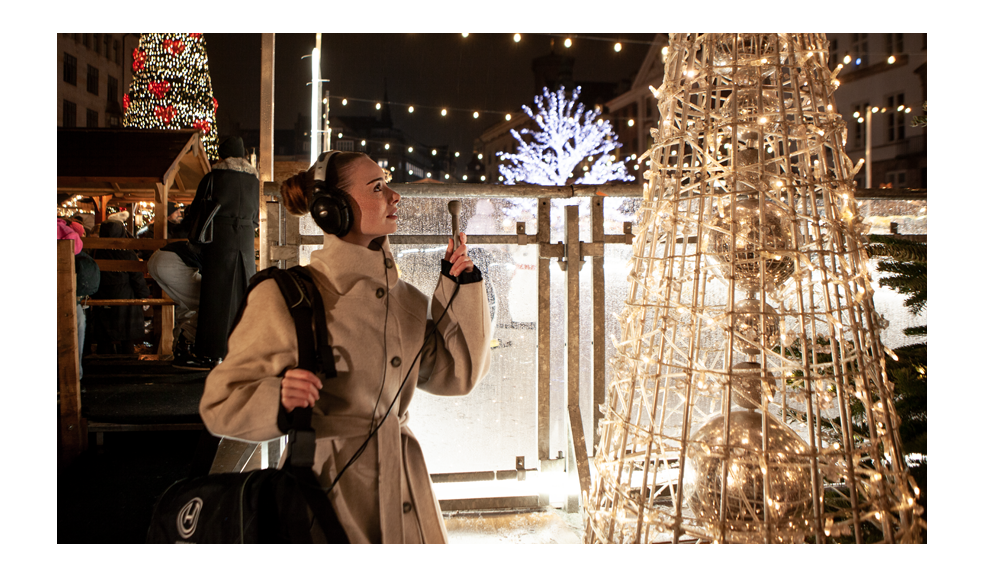
When you walk into the room, resist the urge to dive straight into the interview. Instead, do something that might feel a little awkward:
Politely ask your guest to hold off for a moment.
Stand still, and listen to the room.
Yes, this might feel weird. Your guest might stare at you like you’re channeling the ghost of audio past. But it’s the only way to truly hear what’s happening in the space.
Put a finger in one ear.
This blocks external noise and prevents your brain from “filling in” the gaps with what it thinks the room sounds like.
You’ll hear the actual reflections and noises bouncing around the room.


If the room is workable, look around for the best placement:
Corners or spots with fewer hard surfaces (like windows or bare walls) reduce echoes and reflections.
Move closer to soft furniture, carpets, or curtains to absorb sound.
Sometimes just a small shift can dramatically improve the audio.
Here’s where your earlier scouting pays off.
On the way to the meeting, you might have spotted a quiet park bench, a cozy side room, or even a tucked-away courtyard.
Now’s the time to suggest one of these backups.
You could say:
“This room is great, but it’s a little noisy.
How about we head to that courtyard I saw on the way in?
It’ll be much quieter.”
“I noticed a side room near the entrance.
Would you mind if we moved there?
It’ll help us get the best sound.”
And yes, dragging your guest into a closet full of winter jackets might feel strange, but trust me - your future self will thank you.

Yes, standing in silence with a finger in your ear or relocating your guest to a coat closet might feel embarrassing.
But here’s the thing: most people will go along with it if you explain why.
They trust you to make them sound great.
And when your story sounds crisp and professional, no one will care how many jackets were hanging around you during the recording.

🎁 Today’s Challenge: On your next recording, stop and listen.
Record 30 seconds in your initial space, then try another location.
Like a closet or hallway.
Compare the difference in sound.
Tomorrow, we’ll talk about moving in close—and why physical proximity can transform your interview.

I love Hindy's entire team. From day one, they’ve made me feel like I’m a part of their community.
Stay sharp - join our newsletter and be first in the loop on new stories, updates and blogs.
for iPhone recording
The best audio recorder is the one you have with you at all times, and our field recorder is ready to capture professional-level audio whenever and wherever you are.
Just plug in an iPhone-compatible microphone or use your phone’s built-in options, and you’re set!
We offer simple editing features as well as a one-dial compressor and a clipboard to store your favourite clips.
When you’re ready to export, you can send your session directly to Hindenburg PRO or LITE, or upload it to SoundCloud and a host of other sites. Always be ready.
