

And what is in the session you've got from us.
By Frederik Bjørn
Yesterday we provided a source pack of all the material we have collected, some we used, some we did not.
Now it’s up to you to “remix“ our composition.
If you haven't downloaded it yet you can do so below.
DOWNLOAD SESSION FILES
To create your entry into this years "sounds of Christmas", we have provided you with a fitting source pack of speech, actors and dialogue, ambience, sound effects, and most importantly of all, Christmas music.
The source pack includes:
Speak as made by Nick Dunkerley - with a numbered labelling to indicate the indented order (but don’t feel restricted by it, do as you please!)
An Interview with Danish Christmas Enthusiast and author Benno Blæsild.
Interviews with the children, Adrian and Madelyn and their dad) about their favourite sounds of Christmas.
Interviews with the girl Penny, about her favourite Christmas traditions.
A pack of Christmas carols and music.
A great amount of Ambience and soundscapes
A great amount of SFX sounds.
And remember, if you find yourself needing more sounds, you can always explore the built-in Soundly library inside Hindenburg. It’s packed with even more material to help your story shine.
We wanted to create a scene of an old Norse Viking battling an ogrish monster, you know, to create a sonic version of the harsh reality of living in the Viking times during Christmas.
Brainstorm the Chaos
First step was to do a brainstorm of any possible sounds as well as the narrative sequence we wanted to create.
The warrior’s sword slicing through frosty air
A hulking ogre screeching in a way definitely not approved by any choir
A Viking yelling his lungs out (as you do when a monster appears uninvited)
The wet and slightly disturbing sounds of flesh and gore
And of course… a nice, solid impact for dramatic effect
Once we had the ingredients of carnage mapped out, we started gathering the sound
Collecting the sound effects
After this brainstorm, we gathered these sounds to the best of our abilities. Some sounds from Hindenburg's build in sound library soundly and some we recorded ourselves.
Trying to record your own sounds, or foley, can be a wonderful thing to have laying around at any time, and if you get creative - which you definitely should (even breaking a piece of sealery can be used as a the breaking of bones). remember, homemade sounds add personality, texture, and a lot of freedom when it comes to unplanned comedy.
In this competition we have supplied you with a plethora of sound effects, but we highly suggest to go and fetch some more!
Building the Scene in Hindenburg
With all our raw audio collected, we dropped the clips into Hindenburg and started shaping them into our tiny narrative.
We approached it like a mini story with elements from our brainstorm:
A monster appears (loudly and rudely)
Our Viking responds with a heroic yell
He draws his sword — shing!
He stabs the monster — squelch
The monster’s guts spill out…
The creature demands one more stab before accepting its fate..
By layering different sound effects on top of each other, aligning them using their transients, we adjusted the timing of the spectacle.
To add depth we panned out some of the sounds, to either the right or the left, to create a sense of room.
Our finished example
Here’s a short video showing the full sequence in Hindenburg.
Click the image or the link below to see it.
YETI & VIKING SESSION

Your sound design task!
Try to recreate a small narrative sequence using the steps as outlined above, to any place you find fitting in our production.
This could be anything from making the Christmas feast, to playing with the Christmas presents, to dancing around the Christmas tree.
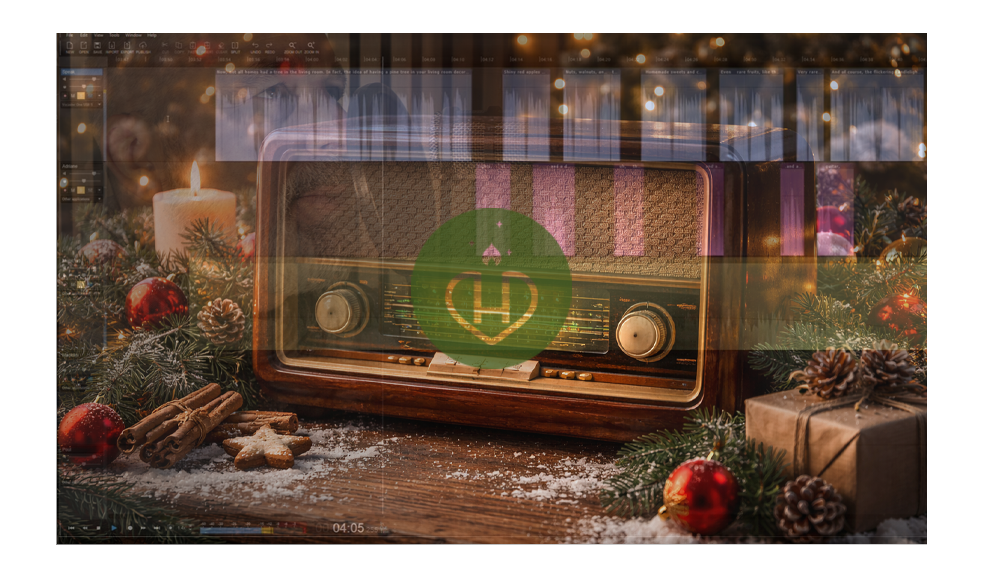
Sometimes, when you have a long stretch of dialogue, it can start to feel a little monotonous, even if the content is great. One simple (and often delightful) way to break that up is by inserting short interview clips or voices from other characters. It adds contrast, personality, and keeps the listener’s attention engaged.
In our example, the main speaker, Nick, is trying to put together a list of ornaments for the Christmas tree. To give the moment a cute and comedic twist, we interviewed a young actor, the five-year-old Adrian, who enthusiastically shares his favourite Christmas ornaments.
To round out the moment, we placed a soft Christmas piano track underneath, mixed to sound as if it’s coming from an old radio. This subtle touch adds a cosy, hygge and homely atmosphere.
Our finished example
Here’s a short video showing the full sequence in Hindenburg.
Click the image or the link below to see it.
SPEAK, KID & RADIO SESSION
Your sound speak editing task!
Try to break up your speak, using any of the provided clips from our actors.
Bedding is the art of placing ambience or music underneath dialogue to support the mood of a scene. It’s one of those subtle storytelling tools that listeners often don’t consciously notice, but they feel it. By choosing different styles of bedding, you can shift the atmosphere: a calm moment can become tense, a neutral conversation can become funny, and a simple monologue can suddenly feel emotional or cinematic.
Sometimes a scene calls for real-world ambience, like the hustle and bustle of a busy street, the calm energy of ocean waves, or the soft hum of a French style café in the background. At other times, what we need is more musical like an evolving ambient drone, a warm pad, or a quiet, composition that gives the moment emotional weight without stealing attention from the dialogue.
Your bedding task!
Try imagining your story as a sequence of small scenes, each with its own personality and energy. Now experiment with giving each scene different types of bedding. Swap out the cosy Christmas Livingroom for a Christmas market ambience, replace a calm Christmas choir with a warm pad... What difference does this make?
How does this change the feeling of the scene?
Does the scene become more intense?
Does it feel calmer or more comforting?
Does it gain a sense of momentum or liveliness?
Does the emotional tone shift in a surprising way?
Bedding is all about experimentation. Play around, trust your ears, and let the sound guide the mood of your Christmas story.

I’ve been using Hindenburg full-time for nearly a decade, and it’s the only audio software I’ve ever truly loved. It’s fast, stable, and beautifully intuitive—built for storytellers, not engineers. You can do precise micro-edits with ease, layer complex scenes quickly, and never get bogged down by bloated features you don’t need. Everything in Hindenburg is thoughtfully designed and genuinely useful. I couldn’t imagine making audio documentaries any other way.
Hindenburg PRO for storytellers
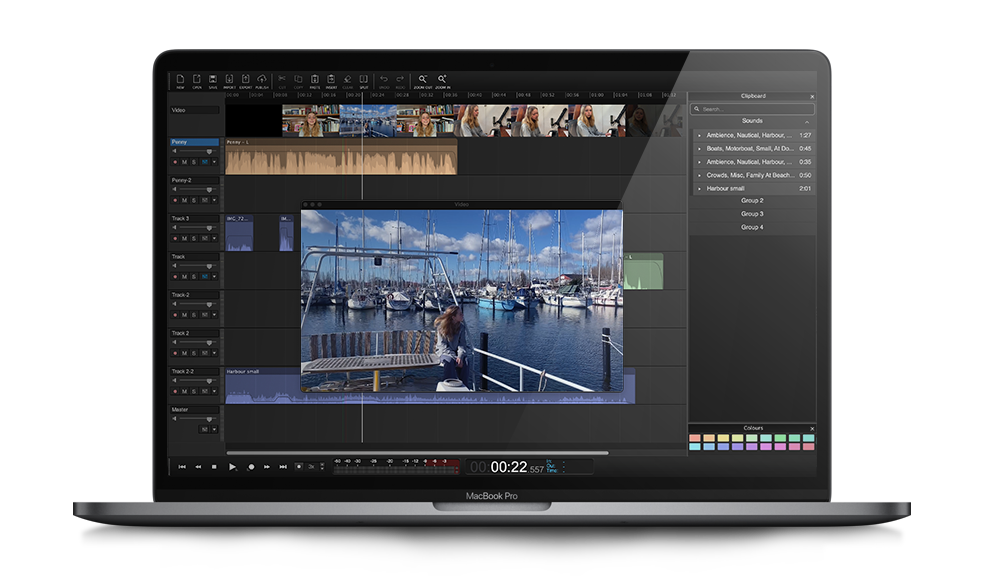
At Hindenburg, we're all about the story. Our tools are designed specifically with audio storytelling in mind, giving you everything you need to navigate and edit complex stories seamlessly. From Multitrack recording, transcriptions, clipboards, sound libraries and publish tools - Hindenburg Pro has you covered.
If you are considering a life in audio, then begin with a 30 day trial of Hindenburg PRO.
Stay sharp - join our newsletter and be first in the loop on new stories, updates and blogs.