

The Twenty-Third Day of Christmas
By Nick Dunkerley
🎄 It’s December 23rd, the day before Christmas - or, at least, it is here in Denmark.
You might still need to wait another day.
But here, it’s a time for last-minute shopping, warming up at a Christmas market with gløgg and sausages, and finishing the grocery list.
The duck, the pork, potatoes, red cabbage, and rice for risalamande pudding.
It’s a day of practicality, and behind Door 23, we also find something practical.
It might not make you feel warm and fuzzy, but it’s essential: the world of export formats, loudness normalisation, and publishing.
Why do we need to export or publish?
Up until now, you’ve been working in your DAW, arranging your story across multiple tracks.
Narration, interviews, music, and ambience.
It sounds great in this "exploded format," but your listeners can’t play it like that.
Exporting merges all the tracks into a single file, typically an MP3, that can be uploaded to a playout system or podcast host.
This is the final deliverable.
Your polished story ready to shine.
Here’s a quick guide to commonly used file formats:
WAV:
Uncompressed, ideal for archiving or professional submissions.
MP3:
Compressed and widely supported, perfect for podcast distribution.
Bitrate Tip: Use 128 kbps for speech or 192 kbps for higher quality.
MP2:
Often used in broadcast workflows.
Opus:
High quality at low bitrates, ideal for streaming or real-time applications.
🎧 Pro Tip: Always save a high-quality WAV file as your master and export MP3s for distribution.
This might be challenging for some, but it doesn’t have to be if you keep these basics in mind:
Sample Rate:
Use 44.1 kHz (standard for audio) or 48 kHz (preferred for professional projects).
Bit Rate:
For MP3: 128 kbps for speech, 192 kbps for higher quality.
For WAV: 16-bit for general use or 24-bit for professional quality.
Mono vs. Stereo:
Use mono for voice-only content; stereo for music or immersive soundscapes.
Loudness measures the perceived volume of audio and ensures consistency across platforms and devices.
Without standardization, your story might be too quiet on one device and deafening on another.
Loudness normalization ensures a smooth listening experience:
Better Listener Experience: No one likes adjusting the volume constantly.
Platform Compliance: Many platforms adjust non-compliant audio, often degrading its quality.
Professionalism: Normalized audio shows care and attention to detail.
🎧 Pro Tip: Think of loudness normalization as gift wrapping. It’s the final touch to present your story beautifully.
Here’s a guide to common loudness standards:
Podcasts:
-16 LUFS is the general standard (e.g., Apple Podcasts).
Some platforms vary: Spotify (-14 LUFS), BBC podcasts (-18 LUFS).
Broadcast Radio:
Europe (EBU R128): -23 LUFS.
U.S. (ATSC A/85): -24 LUFS (e.g., PRSS).
Streaming Services: Platforms like YouTube normalize to around -14 LUFS.
🎧 Pro Tip: If you’re unsure, -16 LUFS is a safe standard for podcasts. Most DAWs can measure and export at the correct LUFS level.
If your story is destined for the airwaves, upload the file to a watch folder in your playout system via FTP (File Transfer Protocol).
This makes it accessible for broadcast.
🎧 Pro Tip: Always check your broadcaster’s specifications for file format, bit rate, and loudness standards to ensure compatibility.
For podcasts, you’ll need a podcast host to store your audio and distribute it to platforms like Apple Podcasts, Spotify, and Google Podcasts.
Here’s why it’s essential:
File Storage: Securely stores your episodes.
RSS Feeds: Creates the feed directories use to list your podcast.
Analytics: Tracks audience size and location.
Ease of Distribution: Publishes your episodes across multiple platforms effortlessly.
🎧 Pro Tip: Popular hosts include Buzzsprout, Libsyn, and Podbean. Choose one based on your needs and budget.
Here are the most commonly used settings:
Podcasts: Export as MP3, 128 kbps, 44.1 kHz, mono, targeting -16 LUFS.
Broadcast Radio: Export as WAV, 16-bit, 48 kHz, stereo, targeting -23 LUFS (EU) or -24 LUFS (US).
Archiving: Save a WAV file, 24-bit, 48 kHz, stereo for future-proofing.
🎧 Pro Tip: Test your final export across multiple devices to ensure clarity and balance.
🎁 Today’s Challenge:
Export your story in two formats: a high-quality WAV file for archiving and an MP3 for distribution.
Test your final export on at least three devices (e.g., headphones, laptop speakers, phone).
Make any last tweaks to ensure your story sounds clear and balanced everywhere.
🎄✨ Tomorrow: It’s Christmas Eve, and your story is ready to shine.
We’ll wrap it all up and celebrate!

When our clients need an audio-only podcast, transcript, or video, Hindenburg Pro 2 is the only editing system I need.
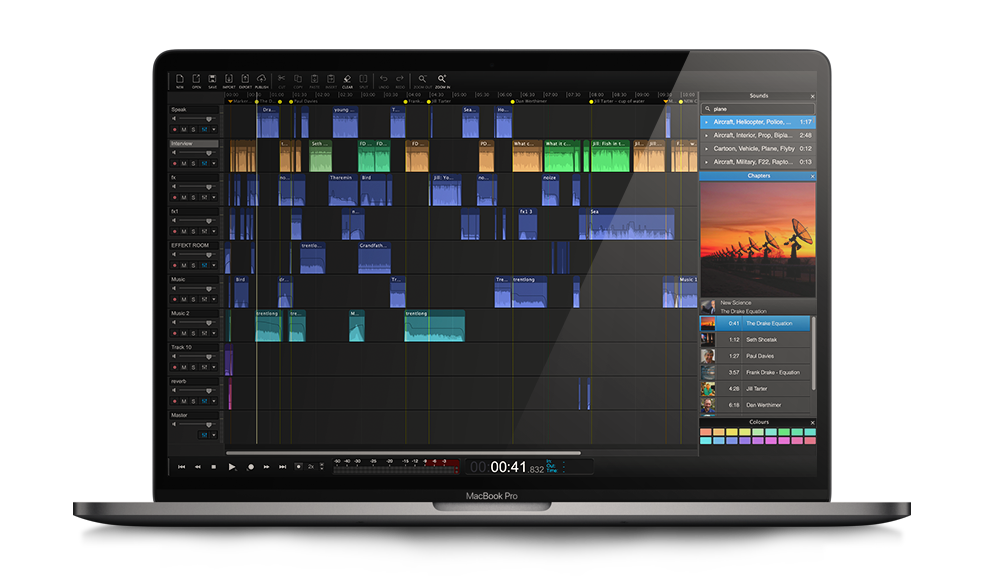
Hindenburg PRO for storytellers
At Hindenburg, we're all about the story. Our tools are designed specifically with audio storytelling in mind, giving you everything you need to navigate and edit complex stories seamlessly. From Multitrack recording, transcriptions, clipboards, sound libraries and publish tools - Hindenburg Pro has you covered.
If you are considering a life in audio, then begin with a 30 day trial of Hindenburg PRO.
Stay sharp - join our newsletter and be first in the loop on new stories, updates and blogs.