

The Twenty-First Day of December
By Nick Dunkerley
🎄 Now that we have the story in place, it’s time for the final touches.
Today is all about rhythm.
Yes, audio stories have a rhythm just like any song.
You might not think about it consciously, but you’ll hear it immediately if the pacing is off.
Try introducing an unusually long pause into your story.
What happens?
Your audience will sit up.
A small change in rhythm can grab attention, or break it, so it’s crucial to get it right.
Beyond pacing, today we’re looking for the perfect mix of music, ambience, and on-location recordings.
In short, the story needs to feel right.
Imagine playing “Enter Sandman” by Metallica while lighting the Christmas tree.
Wrong, right?
It feels out of place.
That’s exactly what we’re avoiding: the story’s soundscape must match the moment.
Every story has a tempo.
A natural beat that carries the audience from scene to scene.
Listen to longer passages of the story and find its rhythm.
Does the pacing feel natural?
Adjust clips that come in too early or too late.
Even a small shift can restore the flow.
Embrace silence: A well-placed pause can say as much as any sound.
Silence isn’t empty.
It’s part of the rhythm too.
Music should enhance the emotion of the story.
It’s not about being “on the nose” with obvious tracks.
Avoid cliché choices:
For example, don’t play “I’m Only Happy When It Rains” in a story about a weather forecaster.
It’s too obvious, and it doesn’t add depth.
Find music that fits the mood:
The right music will feel seamless and invisible.
Like it’s part of the story’s DNA.
That said, it’s perfectly fine to play Christmas music in a Christmas story.
It just has to fit the tone you’re creating.
🎧 Trust your ears:
If it feels right, it probably is.
🎧 A quick note on music rights:
Using music legally is critical.
We’ll dive deeper into this topic another day...
...but for now, we’ll assume you have music that you’re allowed to use.
Play around with your ambient sound to create depth and texture.
Add additional ambience from a sound library if needed.
Some DAWs even come with built-in libraries that make experimenting easy.
On-location recordings can help anchor the listener in a specific place and time.
Use them strategically to enrich the story’s setting.
🎧 Pro Tip: Layering ambience subtly can add incredible realism, but be careful not to overwhelm the narration.
Balance is key.
What you’re aiming for is harmony between narration, music, ambience, and on-location sounds.
Here’s the golden rule:
Set your narration levels as the baseline.
Once the narration is balanced, don’t move it.
Everything else must fit around it.
If the music is too loud and drowns out the narration, turn the music down.
Do NOT turn up the narration.
This keeps the mix clean and natural.
Your mix should feel smooth and seamless.
The listener should never be pulled out of the story because the levels are jarring or uneven.
🎁 Today’s Challenge:
Listen to a section of your story.
Focus on its rhythm and pacing.
Are there any breaks in the flow?
Adjust pauses, timing, or clip placement until it feels natural.
Add or refine music and ambience to match the tone of the story.
Play around with layers and subtle details.
Balance your mix: Set the narration as your baseline, adjust music and ambience levels, and ensure nothing overwhelms the voice.
🎄✨Tomorrow: We’ll explore the final mix, sound treatment, and how to wrap your story up with a bow.

It is intuitive, easy to use, and FAST when it comes to editing, and at the end of the day, I am able to produce 23 hours of quality radio content every week. Don’t let the simple controls fool you.
Hindenburg PRO for storytellers
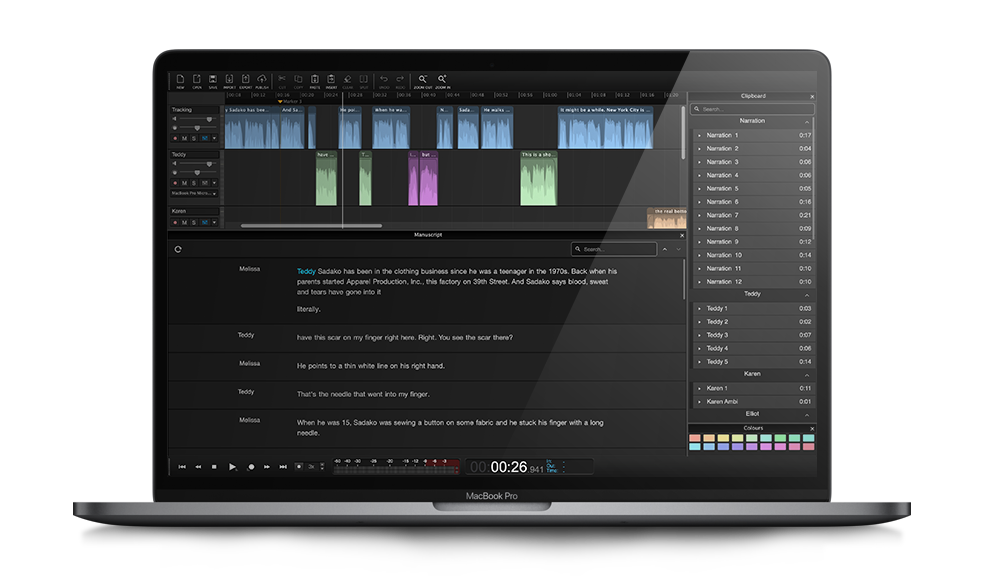
At Hindenburg, we're all about the story. Our tools are designed specifically with audio storytelling in mind, giving you everything you need to navigate and edit complex stories seamlessly. From Multitrack recording, transcriptions, clipboards, sound libraries and publish tools - Hindenburg Pro has you covered.
If you are considering a life in audio, then begin with a 30 day trial of Hindenburg PRO.
Stay sharp - join our newsletter and be first in the loop on new stories, updates and blogs.